Ask your local nusserary for help picking a forgiving plantA bonsai
takes years not days to develop
Starter Tools:
Shears: you need a pair of scissors which will allow you to do he fine work of trimming
in a small space. You can get these for bonsais.
Concave Cutters: The purpose of these is to cut without injuring the plant.
Wire and Wire cutters: The wire is to shape the plant the wire cutters are for cutting
the wire.
The Look:
Formal
Upright (Chokkan)
For a tree to be a formal upright, it must have a very straight trunk and a very
balanced distribution of branches. The goal is to develop a sense of balance, but not
strict symmetry. The first branch should be the most developed and should be positioned
roughly a third the height of the tree. This style is best suited to conifers.
Informal Upright (Moyogi)
Informal uprights are one of the most common styles. This is the most basic design in
that it follows the natural structure of the tree's trunk. The goal is to develop a single
line of the trunk, reaching from the roots to the apex while producing a natural structure
of branches and foliage. Again, the branching starts about a third of the way up, and
there should be little or no empty spaces. Most deciduous trees will be best suited to
informal upright styles.
Slanting (Shakan)
The "slanting" of this style refers to the direction of the movement of the
tree's trunk. A Shakan bonsai will have a very distinctive slant, often time balanced out
by very strong rootage on the opposite side of the trunk. The goal of shakan is to balance
the movement of the trunk with the placement of the branches so that the tree does not
appear to be lopsided. A slanted style tree can often give a very powerful impression of
strength and age.
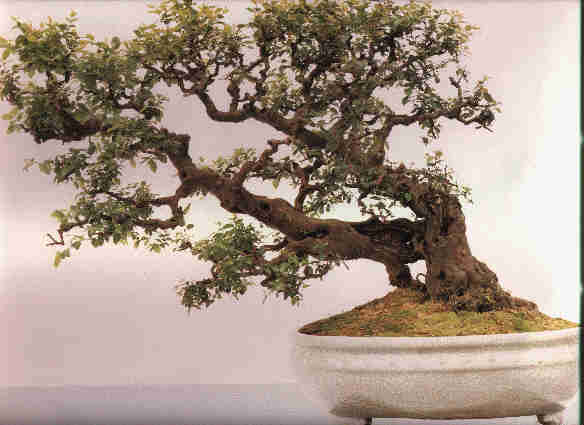
Cascade (Kengai)
These trees give the appearance of a waterfall or cascade of foliage which spills over
the pot and down toward the ground. The casade should have a small crown above the top of
the pot and a long cascading main branch that flows from the lower portion of the trunk to
the apex. Ideally, the tip of the cascade should line up with the line of the trunk. These
trees, which often times simulate the growth of a tree along a mountain's side, exhibit
both strength and beauty.
Windswept (Fukinagashi)
This style simulates the effect of sustained
exposure to strong winds. In this design, each of the branches appears to be
"swept" to one side, as if being blown by a strong wind or having large portions
of foliage and bran~hes stripp~d by environmental conditions. These trees are modeled on
trees usually found in coastal areas, where strong envimomental forces have shaped and
sculpted
Bunjin (literati
Style)
This style is the most unconventional of them all. Bunjin often have long
thin trunks which curve back around toward the front at the top, displaying the tree's
foliage in a cascading form. It is not uncommon to see Japanese Red Pines shaped in this
style. This style technically "breaks the rules" in a number of ways, but also
imitate trees in nature that have been forced to contort themselves to survive. Often the
result of adverse -conditions, bunjin show us how nature itself "breaks the
rules" in order to survive, not infrequently with astounding grace and